


Back
The Collaborative Learning Commons: Physical Space and Educational Philosophy
A large, open space for collaboration, creativity, and critical thinking in their school helps prepare students for success in today's world.
The Collaborative Learning Commons is much more than just a physical space, it’s an educational philosophy. It transforms the way students learn by promoting collaboration, creativity, and critical thinking. With its focus on student engagement, flexible design, and integration of technology, these spaces reflect the needs of modern learners. By facilitating collaboration across disciplines and creating opportunities for hands-on, real-world learning, the collaborative learning commons prepares students for success in an interconnected, fast-evolving world.

Collaborative learning commons can be used for Active Project-Based Learning (APBL) which is a process that allows students to engage in solving authentic, real-world opportunities. With research, producing a final product, and learners sharing their conclusions with classmates, students can successfully complete their discovery process. APBL activities can include many learning classifications where students manage their own learning process. These activities may include large group project initiatives with authentic, real-world companies as collaborative team members, small group investigative teams with mock-up examples, and several critical evaluations and revision submissions. The commons should include movable, flexible furniture and mobile flat-panel screens.
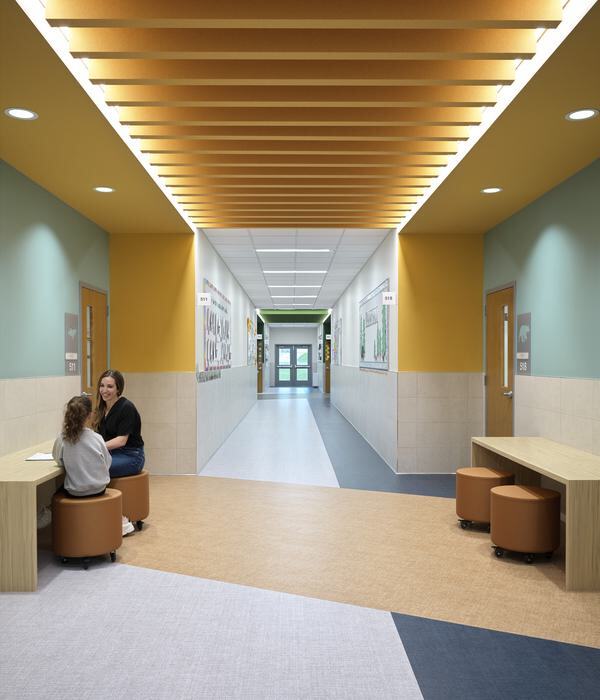
The collaborative learning commons is designed for flexible group sizes from large to small that engage in a variety of collaborative activities. It is a multidimensional, informal learning environment with access to storage, sink, learning materials, power, Internet, and hard and soft flexible seating that includes both standing and sitting options. Ideally, it has abundant natural daylighting that positively stimulates the students throughout the day. Variable wayfinding, inspirational murals, and artificial lighting can define its zones. The space can be filled with student worktables, writing walls, flat panel technology screens (both fixed and movable), and displays for two-dimensional and three-dimensional work produced by students. When it is centrally located in an academic cluster with classroom studios around it, utilizing full transparency between the learning commons and classroom learning studios, everyone can see learning happening and teachers can effectively supervise all activities.
A collaborative learning commons in schools is a dynamic, flexible space designed to support active, student-centered learning. It’s not just a place for studying or accessing resources, but a vibrant environment where students, teachers, and even community members can engage in collaboration, creativity, and problem-solving. These spaces encourage group work, sharing of ideas, and interdisciplinary learning, fostering skills that are essential for today’s rapidly changing world.
News & Insights
All Articles
FGMA Earns Great Place to Work Certification
