
Back
Trauma-Informed Design Shapes Spaces that Heal, Empower and Support Community

When residents of Juniper Creek stepped into their new homes, they found a housing environment intentionally crafted to support well-being, dignity and connection. Central to this apartment complex is a design approach that reaches beyond aesthetics and function: Trauma-informed Design (TiD).
The walk from home to the courtyard feels intuitive. Residents can see where they're going. They can see how to leave. There are no confusing turns or hidden corners, just clear paths, open views and a sense that the space is working with them, not against them.
That feeling is intentional.
Fundamentally, trauma-informed design asks, “How can the built environment reduce harm, promote safety and create the conditions for people to thrive?” This question guided the Spring Architects team — acquired by FGMA in 2025 — from early conversations about Juniper Creek through the ribbon cutting in February 2026, responding directly to a client request to apply a TiD framework to the affordable, supportive housing community.

Juniper Creek celebrated its official Ribbon-Cutting on Thursday, Feb. 12, 2026; dozens of families already call this place home.
The result is a project that reflects architectural excellence along with a deep commitment to the human experience: spaces that respect privacy while encouraging connection, that offer choice without overwhelming, and that welcome rather than inadvertently trigger stress. Safety, equity and community are embedded in how residents move and feel within Juniper Creek’s 110 home units and site.
“FGMA is an invaluable partner in Foundation Communities’ efforts to build dignified affordable housing,” shared Jason John Paul Haskins, Director of Construction & Design at Foundation Communities. “We have learned and grown alongside their team, constantly improving the sustainability, trauma-informed responsiveness and quality of life of our communities.”
Beyond Housing: A Place to Belong
Juniper Creek includes 110 one-, two- and three-bedroom homes across three buildings, offered to families at or below 60% of the area’s median income. Located next to Foundation Communities’ Laurel Creek development, residents can access nearby learning centers, food pantries, health education, after-school programs and outdoor spaces designed for all ages.
For families seeking stability after periods of uncertainty, these connections matter. TiD recognizes that healing does not happen in isolation; it happens through access, community and the ability to feel at home.


The family-centered apartment community features a playground nestled among trees in close proximity to an apartment building.
What is Trauma-informed Design?
As stated by the Trauma-informed Design Society,“TiD is the practice of integrating the principles of trauma-informed care, as originally established by the Substance Abuse and Mental Health Services Administration (SAMHSA) and continually evolving, into design. The goal is to create physical spaces that promote safety, well-being and healing.”
Trauma-informed Design begins with a simple understanding: the spaces we inhabit influence how we feel, how we move and how we connect.
Andrea achieved the Trauma-informed Design Society (TIDS)’s TiD – Bronze credential and has applied the TiD framework to projects like Juniper Creek. "All practices benefit from policies and environments that actively resist re-traumatization,” said Andrea.
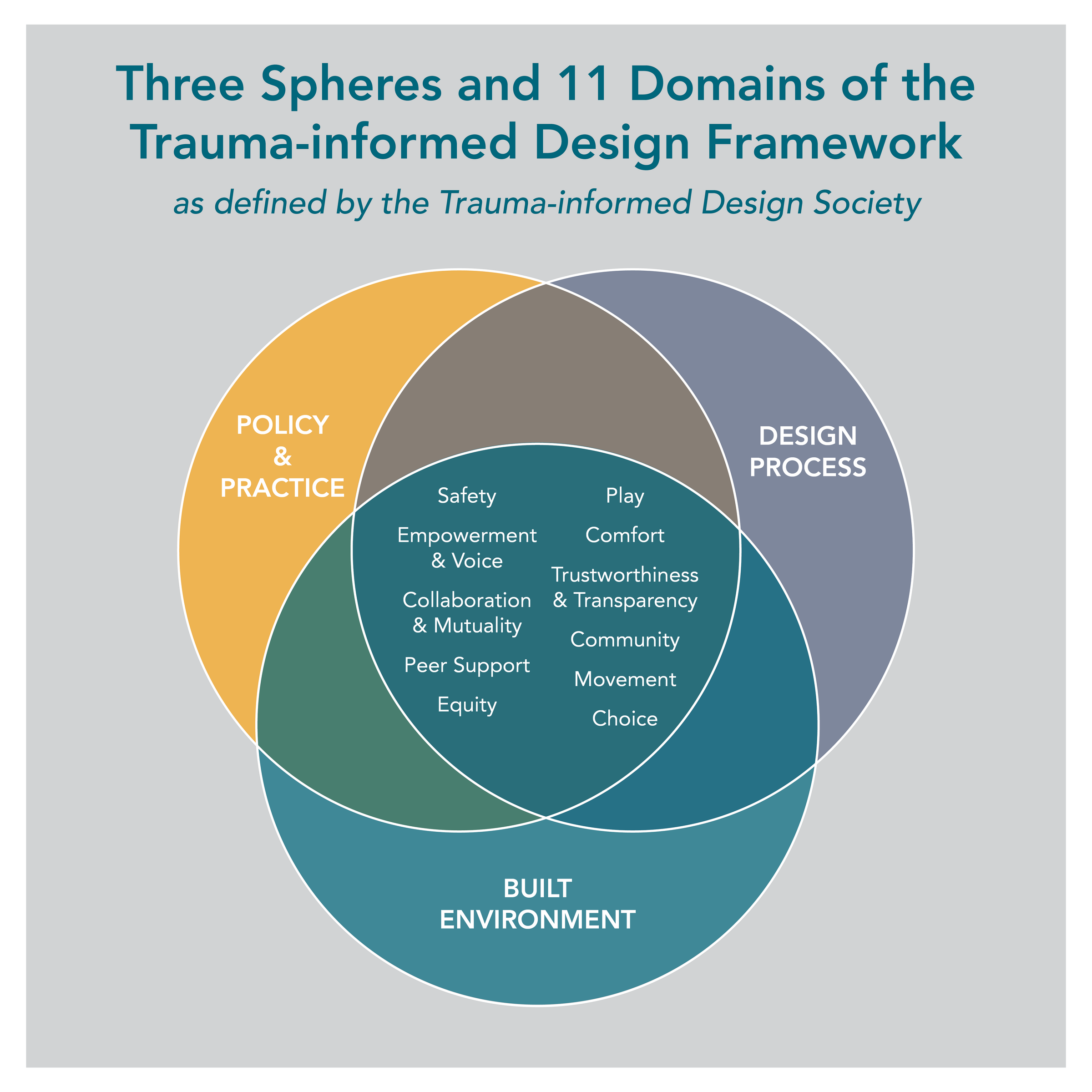
This graphic illustrates the Trauma-informed Design Society’s framework for design, including the three spheres and 11 domains that lay the foundation for the approach.
By applying TiD approaches through a lens of trauma-informed care, we create holistic, empathetic environments where individuals feel supported and at ease, allowing both body and mind to settle.
What Trauma-informed Design Looks Like in Practice
At Juniper Creek, trauma-informed design is subtle and still powerfully impactful:
Clear sightlines and intuitive circulation
help residents quickly understand their surroundings: wide hallways, no blind corners or dead ends and two visible exits all support physical and psychological safety.
Shared spaces invite ease rather than stress.
The community laundry room was designed more like a lounge than a utility space: open, comfortable and welcoming. These conscious choices turn everyday tasks into moments of calm.
Safety is reinforced through connection, not surveillance.
The leasing office maintains clear views of the street and shared spaces, creating a sense of presence and care. Amenities are located nearby, reinforcing support without disrupting privacy.
Intimacy is balanced with transparency.
Within the open leasing office, wood slatted walls create semi-enclosed, comfortable, human-scaled areas while still maintaining visibility and connection. These spaces support a trauma-informed approach without sacrificing openness.
Choice is embedded throughout the community.
All homes are mobility accessible; residents can move through the site using their choice of elevators, ramps or stairs. This flexibility supports independence and autonomy.
Wayfinding cues,
including color banding and material repetition, provide visual clarity while connecting Juniper Creek to its neighboring Laurel Creek community. Exterior colors inspired by juniper trees ground the development in nature; murals and sculptural elements by local artists reflect the broader neighborhood identity.
Even subtle design gestures,
like soft seating areas, plants or access to daylight, improve relaxation when people are mentally or emotionally stressed.

Juniper Creek’s leasing center has an interior window into the manager’s office, ornamental screens offer privacy without blocking views and two separate, visible exits.
Looking Ahead: A Shift to Human-Centered Design
Juniper Creek reflects a shift in architecture that recognizes buildings as active participants in people’s lives. When design prioritizes safety, dignity and belonging, it strengthens community.
Projects like Juniper Creek remind us that thoughtful design doesn’t need to announce itself loudly. Sometimes, its success is simply how welcoming a space feels when you walk through it.
And sometimes, that feeling can make all the difference.


Learn More About Juniper Creek Apartments in Austin
ABC’s KVUE News Report: Ribbon-cutting held for new affordable housing community in North Austin
City of Austin’s Announcement, Juniper Creek Apartments Ribbon-Cutting Ceremony: Celebrating the Launch of More Affordable Housing
Trauma-informed Design FAQs
How is Trauma-informed Design different from general wellness or biophilic design?
While wellness and biophilic design focus on health and connection to nature, TiD specifically considers how built environments may trigger stress responses related to past trauma. It prioritizes safety, predictability, agency and dignity, emphasizing reducing the risk of re-traumatization. Notably, a TiD approach also includes the design process and policies and practice, applying the same principles to all three spheres.
What are common triggers that an environment might unintentionally have?
Common environmental triggers often relate to loss of control, sensory overload or perceived threat. Examples include: harsh or flickering lighting, loud acoustics, confusing wayfinding, hidden exits, limited visibility, lack of privacy for sensitive conversations, layouts that reinforce power imbalances. Thoughtful, empathetic design helps reduce these stressors.
Is Trauma-informed Design only relevant for multifamily housing?
While TiD is especially impactful in settings serving vulnerable populations (think housing, healthcare, education, community services), its principles benefit all environments. Designing for comfort and agency improves experiences for everyone, regardless of background.
Does Trauma-Informed Design significantly increase project costs?
Not necessarily. Many TiD strategies, like improving wayfinding, enhancing acoustic comfort, providing clear sightlines and offering seating or lighting choices, can be integrated within existing budgets. Early planning and intentional decision-making are key to aligning trauma-informed principles with project goals and resources.
News & Insights
All Articles
Community Engagement Shapes Meaningful School Design